
AGENCY EVALUATION / PROPOSAL REVIEW
Dental SEO Red Flags: How to Read a Proposal
The most useful dental SEO agency red flags are claims you cannot verify, work nobody has defined and access arrangements you cannot inspect. Mark up the proposal before discussing the retainer. Ask the agency to connect each recommendation to a real page, a practice priority and a checkable next step.
AI narration · UK English

Which promises should make you pause?
Pause when a proposal guarantees a search position, claims special influence over Google or presents a forecast without assumptions. Ask what the supplier will actually do and how it will demonstrate progress. A credible answer should make the delivery clearer without turning uncertainty into a sales promise.
Google’s advice on hiring an SEO explicitly warns against guaranteed first-place rankings. Use that as a reason to request revised wording and a defined scope. The agency can commit to specific work and communication; the search engine decides what to show for a particular query.
Consider the illustrative phrase “top three for every implant search in 30 days”. Ask which searches, which locations, which device and which result type the salesperson means. Then ask for the proposed changes and their dependencies. A broad claim can collapse into a narrow ranking observation once the terms are defined.
Keep a note of the original statement and the clarification. If the written proposal still sells a certainty that the delivery team cannot substantiate, stop the buying process until the contradiction is resolved. Your decision concerns the reliability of this offer, not an accusation about every service the company provides.
How can you identify vague or unnecessary deliverables?
Ask every deliverable to name the problem, affected page and expected practical change. A large task count does not establish that the work matters. Separate work that fixes access or booking problems from work that merely produces a report or repeats information already available.
“Optimise 100 keywords” is incomplete without a query-to-page map. Ask which searches represent implant consultations, urgent appointments or another genuine service. The supplier should explain whether the existing page serves the reader or whether a distinct page is justified. A practice does not need a new URL for every wording variation.
“Publish daily AI content” raises different questions: who writes the brief, what original value is added, who checks treatment claims and which existing articles overlap? Ask for one worked brief before agreeing to volume. Our dental SEO audit sample shows the kind of finding-and-retest format a buyer can inspect.
Likewise, “technical fixes” should identify the fault and the party that can change it. If the agency only sends recommendations to your developer, make the implementation boundary visible in the price and schedule. Buy a defined improvement, then use task counts to check delivery.
What should you ask about link building and AI visibility?
Request examples of the methods, placements and claims being sold. Ask why they help the practice’s readers and which official policies the approach follows. Treat guaranteed AI mentions, undisclosed paid placements and secret techniques as unresolved risks until the supplier explains them.
Google’s spam policies cover link spam and other manipulative practices. Ask whether the agency buys links intended to influence rankings, uses automated placements or creates sites primarily to funnel searches elsewhere. Request a written description rather than accepting a proprietary-methods explanation for everything.
A useful AI-search proposal names the information gap it intends to fix and distinguishes a citation, a referral visit and a patient enquiry. Ask for a repeatable observation method, a query set and limits on interpretation. A screenshot of one favourable answer does not establish consistent visibility for the practice’s patients.
Do not reject all automation. A tool can help collect a crawl or organise an editorial checklist. Ask who reviews the output, which decisions require a person and how mistakes are corrected. The red flag is unaccountable output sold as assured business performance.
What does a marked-up proposal look like?
Use a simple register with the claim, the missing detail and the question you need answered. Keep factual concerns separate from preferences about price or communication. The following invented example shows how to turn a sales document into a short, productive clarification meeting.
Illustrative proposal: “£900 monthly, 100 keywords, guaranteed Maps growth, ten articles, all accounts managed for you.” The amount is not a market benchmark. The words do not tell you the clinic covered, implementation scope, quality review or account roles. Those gaps matter more than whether the presentation looks polished.
For “100 keywords”, ask for the treatment-and-location map. For “ten articles”, ask for briefs, clinical sign-off and overlap checks. For “all accounts”, ask the supplier to demonstrate practice ownership and delegated permissions. For “Maps growth”, request the measurement definition and remove any unsupported placement guarantee.
End the meeting with a revised scope and named owners. If the agency answers only by adding more deliverables, bring the discussion back to the practice’s constraint. You may need one broken appointment route repaired before another content campaign has a useful destination.
| Proposal wording | Missing evidence | Question to resolve |
|---|---|---|
| 100 keywords | Priority pages and patient task | Which services and locations will the work support? |
| Ten articles | Briefs and review owner | Who checks accuracy and existing-page overlap? |
| All accounts managed | Practice access and recovery | Can we verify owner and delegated roles now? |
| Maps growth | Defined observation method | Which queries, location and outcome will be reported? |

How can you judge evidence and reporting fairly?
Ask for the dates, baseline, work completed and outcome definition behind any case study. Then check whether the example resembles your practice’s situation. Provider-published results can be a useful starting point, but they need context before they can support a decision about your own budget.
An illustrative chart showing traffic rising from 200 to 400 visits represents a 100% increase, but tells you little about patient fit or appointment demand. Ask which pages grew, whether the practice changed its offer and whether enquiry tracking was working throughout. Do not translate the percentage directly into expected revenue.
Ask whether you can see reports that separate calls attempted, forms successfully saved, enquiries qualified and consultations booked. Those are different stages. If reception cannot currently reconcile them, a sensible proposal can begin by improving measurement rather than pretending the complete answer already exists.
For a UK practice, clinical claims need appropriate oversight under the GDC’s advertising guidance. US buyers should confirm the applicable professional and privacy requirements for their jurisdiction. The commercial questions travel across markets; regulatory assumptions do not automatically do so.
When should you clarify, negotiate or walk away?
Clarify missing details when the supplier can answer with evidence and revised wording. Negotiate scope or terms when the offer is understandable but does not fit your practice. Walk away when material promises remain unsupported or the supplier refuses to explain access and delivery.
Bring the same short worksheet to every agency conversation. Record who answered, which supporting file they provided and whether the answer reached the revised proposal. A helpful salesperson may resolve a question verbally while the delivery team continues working from the original scope. Close that gap before comparing fees. Ask the person who will lead delivery to confirm the first action and the information they need from your practice.
Use three decision categories in your review. “Ready” means the work, owner and acceptance check are clear. “Clarify” means an answer or attachment is missing. “Hold” means a material issue must be resolved before commitment. Apply the same categories to every agency so sales confidence does not dominate the comparison.
Check the dental SEO contract checklist once the proposal makes sense. The proposal explains the recommended work; the agreement needs to capture the obligations you are actually accepting. Keep the approved version and important attachments together.
If you want a second view on the technical priorities, start with our dental SEO audit and compare the finding with your current proposal. Our wider dental SEO service explains the delivery approach. Choose a first action that your practice can verify before committing to an expansive programme.
Sources and photography
Platform and professional guidance is linked beside the relevant claims in this guide. Reviewed on 19 November 2026. Examples and worksheet figures are illustrative and do not describe a client result.
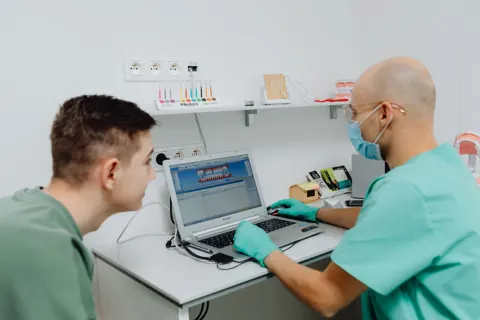
Cover photograph: Dentist Working on Laptop, Bakytzhan Baurzhanov. Inner photograph: Man in a Dentist Office, Pavel Danilyuk. Used under the Pexels License. The stock subjects do not endorse RankDigital and are not presented as our staff, clients or the practices in our examples.
Key takeaways
- Ask for evidence behind performance promises.
- Map deliverables to real pages and patient tasks.
- Separate reporting activity from confirmed bookings.
- Resolve material gaps in writing before committing.
Summarise this article with AI
Open an assistant. For Claude, Grok or Poe, copy and paste the prompt.
 ChatGPT
 Claude
 Perplexity
 Google AI Mode
 Quora Poe
View or copy the prompt
Related articles
 RankDigital
What Should Your Dental SEO Contract Include?
Use this dental SEO contract checklist to review scope, fees, account access, reporting and exit arrangements before your UK practice signs.
Explore RankDigital
Best Dental SEO Agencies in the UK: A Buyer’s Guide
Compare six UK dental SEO providers by service scope, reporting and the questions to ask before you hire. Includes screenshots and a buyer scorecard.
ExploreSTART WITH YOUR BIGGEST OPPORTUNITY
Let’s turn the next question into a clear plan.
Share your website, your priorities and what you want to improve.
Request your free audit