
DENTAL GROUPS / WEBSITE ARCHITECTURE
Dental Group SEO: One Site or Separate Clinic Websites?
Choose a dental group website structure for SEO by deciding how patients recognise your clinics and how your team maintains accurate information. One shared-brand website with useful clinic pages is often the simpler operating model. Separate websites can make sense for genuinely distinct brands, provided each has an accountable owner and maintenance plan.
AI narration · UK English

When does one website make sense for a dental group?
Use one website when the clinics share a public brand, a patient proposition and a team that can maintain common templates. Give every real branch a helpful destination within it. The practical advantage is a more consistent patient journey and a manageable publishing system, rather than a guaranteed ranking benefit.
Start with a patient task. Someone looking for an urgent appointment needs the correct clinic’s address, opening information and contact route. Someone researching a group-wide implant service may need an overview followed by a branch choice. Your architecture should connect those tasks without sending every visitor through a corporate introduction.
An illustrative shared-brand structure could use /clinics/bristol/ for branch information and /treatments/dental-implants/ for the general treatment explanation. The branch page states whether that treatment is available there and links to the relevant booking route. These are planning examples, not existing clinic URLs or a universal template.
Write a content ownership rule before choosing the platform. The central team maintains shared treatment information, while each clinic verifies its local facts. A single site still becomes unreliable if nobody owns hours, clinician changes or appointment instructions. See our dental website design service for the implementation questions to put into a brief.
Before a workshop, ask each practice to supply one common patient question and one detail that differs from the other branches. Use those answers to sketch navigation and page responsibilities. If nobody can explain a meaningful difference between two proposed location pages, investigate the actual clinic information before approving content production. This keeps the structure tied to real operating facts while the business decides how far to standardise its public brand.
When are separate practice websites justified?
Keep separate websites when practices retain distinct patient-facing brands, offers or operating arrangements that need independent presentation. Make that a documented business choice. Each site needs its own accurate content, technical maintenance, account access and booking checks, so include those responsibilities in the decision.
Consider an illustrative acquisition: a group buys two established practices but intends to retain their names and local identities. Keeping their websites may help preserve the patient experience while the group standardises internal reporting. A holding-company site can explain ownership without replacing the useful local sites.
Now consider the reverse: four branches adopt one name and share reception systems. Continuing to maintain four nearly identical sites may create unnecessary work and inconsistent information. That is a reason to evaluate consolidation, not proof that the separate sites cannot perform in search.
Avoid selecting the model solely because a supplier prefers its own CMS or charges by website. Ask for the maintenance plan, editorial capacity and total cost under both options. If there is no clear owner for four sites, the apparent flexibility can become four sets of stale facts.
What should every clinic page help a patient do?
A clinic page should let a patient identify the correct location, understand the relevant services and contact the right team. Include branch-specific facts that somebody at the practice can verify. If two pages differ only by a place name, revisit whether each one serves a distinct reader task.
Prepare a local fact sheet covering the actual practice name, address, phone, hours, team, treatments and access information. Add directions, parking or step-free access details only when verified. Do not imply a treatment or appointment type is available at every branch because it appears on the group’s general service list.
For UK practices, review the GDC’s website and advertising guidance, including accurate practice and professional information. Give the responsible person a review date. Stock photographs should not be presented as the actual branch or its clinicians.
An illustrative Bristol patient journey is: select Bristol, confirm the address, check whether implant consultations are offered, then use the Bristol contact route. Test that journey on a phone with somebody who did not build the site. Record the point where they hesitate before deciding which navigation label to change.
How should you compare the architecture options?
Compare each option against brand clarity, local usefulness, maintenance and change risk. Mark unknowns before calculating a score. A decision table is most useful when it exposes a dependency, such as a missing clinic editor or a planned rebrand, rather than manufacturing an objective winner.
Use an illustrative three-column worksheet: decision factor, one shared site, separate sites. Under brand continuity, record whether patients expect the same name. Under maintenance, record who approves shared and local copy. Under booking, show whether callers reach one team or separate practices. Under reporting, define the branch identifier each route needs.
For a hybrid group, keep the shared-brand clinics together and retain independently branded practices where the business case supports it. Document how patients move between group and local information. Do not hide essential branch details behind a corporate directory that only lists names and links.
Choose the structure your team can keep accurate. A technically neat diagram does not compensate for a booking button that points to the wrong clinic. Ask your developer and practice managers to review the same example journey before the scope is approved.
| Factor | Shared site | Separate sites |
|---|---|---|
| Public brand | One recognised group name | Distinct local practice identities |
| Editorial owner | Central templates with branch checks | A named editor for every retained site |
| Booking route | Branch selection stays clear | Each site reaches its own team |
| Change plan | Map acquired URLs before merging | Keep maintenance and reporting accountable |
What changes if you merge existing clinic websites?
Treat a merger as a migration with a page inventory, destination map and verification plan. Keep useful existing URLs when the project allows it. Where addresses change, map old pages to the most relevant new destinations and test the patient journey as well as the technical response.
Google’s site-move guidance explains redirects, URL mapping and monitoring for moves that change addresses. Build those tasks into the project schedule. A domain merger should have a named owner for the old domains, redirects and post-launch checks.
Before building, list the pages that currently receive relevant visits, external links or enquiries using the data available. Record the corresponding new destination and who signs it off. An old Bristol contact page should lead to an appropriate Bristol destination; a generic homepage is unlikely to complete the same patient task.
Plan the change in manageable stages where possible. Avoid combining an untested booking-system replacement, a full rebrand and a large content removal without clear accountability. Our technical SEO service can help define the migration checks, while reception verifies that the correct clinic still receives enquiries.
How do you measure success across clinics?
Keep a group overview while retaining a branch-level view of important journeys and outcomes. Agree the clinic identifier, reporting period and enquiry definition before launch. The group needs to see whether a change helps patients reach the right practice, rather than relying only on total traffic.
An illustrative dashboard can list each clinic, the relevant landing pages, observable enquiry actions and confirmed bookings supplied by the practice. Keep a separate status for unknown or unassigned enquiries. If the booking system cannot share reliable outcomes, state that limitation rather than treating every button click as a booked consultation.
Review local facts and contact paths after staffing, opening-hours or service changes. Include a branch representative in the review because the website team may not know that a treatment has moved to another clinic. A small operational update can matter more to the patient than another general article.
For US dental groups and DSOs, the same architecture questions apply, but confirm the relevant professional and privacy requirements locally. This guide uses UK editorial examples and does not treat one country’s rules as universal. Start with a dental SEO review of the real sites and ownership plan, then decide what to retain, consolidate or rebuild.
Sources and photography
Platform and professional guidance is linked beside the relevant claims in this guide. Reviewed on 19 November 2026. Examples and worksheet figures are illustrative and do not describe a client result.
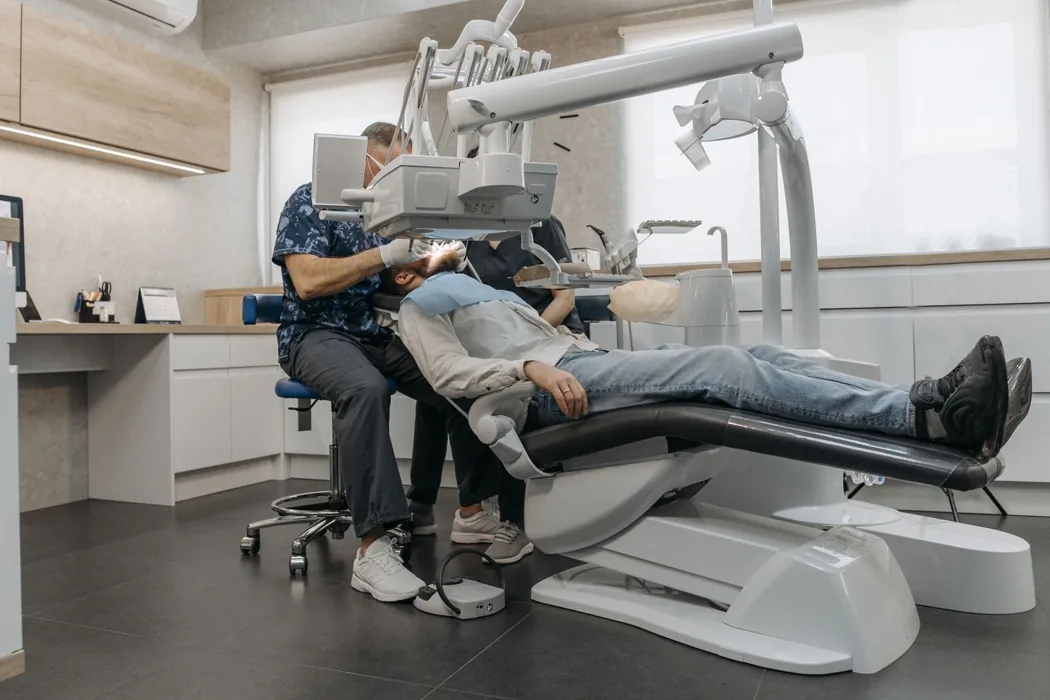
Cover photograph: Dentist having a Discussion with a Patient, Kaboompics. Inner photograph: A Dentist in a Clinic Working on a Patient, Pavel Danilyuk. Used under the Pexels License. The stock subjects do not endorse RankDigital and are not presented as our staff, clients or the practices in our examples.
Dentist having a Discussion with a Patient
Key takeaways
- Match the public brand and patient journey before choosing domains.
- Give each real clinic accurate local information and a clear booking route.
- Budget for maintenance across every retained website.
- Treat consolidation as a migration with branch-level checks.
Summarise this article with AI
Open an assistant. For Claude, Grok or Poe, copy and paste the prompt.
 ChatGPT
 Claude
 Perplexity
 Google AI Mode
 Quora Poe
View or copy the prompt
Related articles
 RankDigital
Local SEO for Dentists: The UK Google Maps Guide
Use a location checklist to improve your dental practice’s Google Business Profile, fix branch mismatches and measure Maps interactions and enquiries.
Explore RankDigital
Dental Website Conversion Checklist for UK Clinics
Test mobile calls, appointment forms, scheduling and accessibility with a dental website conversion checklist that follows enquiries through to reception.
ExploreSTART WITH YOUR BIGGEST OPPORTUNITY
Let’s turn the next question into a clear plan.
Share your website, your priorities and what you want to improve.
Request your free audit