

Picking a tech stack looks like a technical decision. It isn’t. It’s a hiring decision, a budget decision, and a three-year maintenance commitment that someone will inherit long after the launch party.
Most guides hand you a list of fifteen frameworks and wish you luck. This one does the opposite: it starts with the kind of application you’re building and works backwards to the technology that fits — including the cases where a popular choice is the wrong one.
What are the best technologies for web app development in 2026?
The best technologies for web app development in 2026 are React with Next.js for the frontend, Node.js or Python for the backend, PostgreSQL for the database, and AWS, Vercel or Azure for hosting. This combination covers most SaaS platforms, dashboards and customer portals. Enterprise systems, high-volume content platforms and AI-heavy products each call for a different mix.
Match the stack to the project, not to the trend
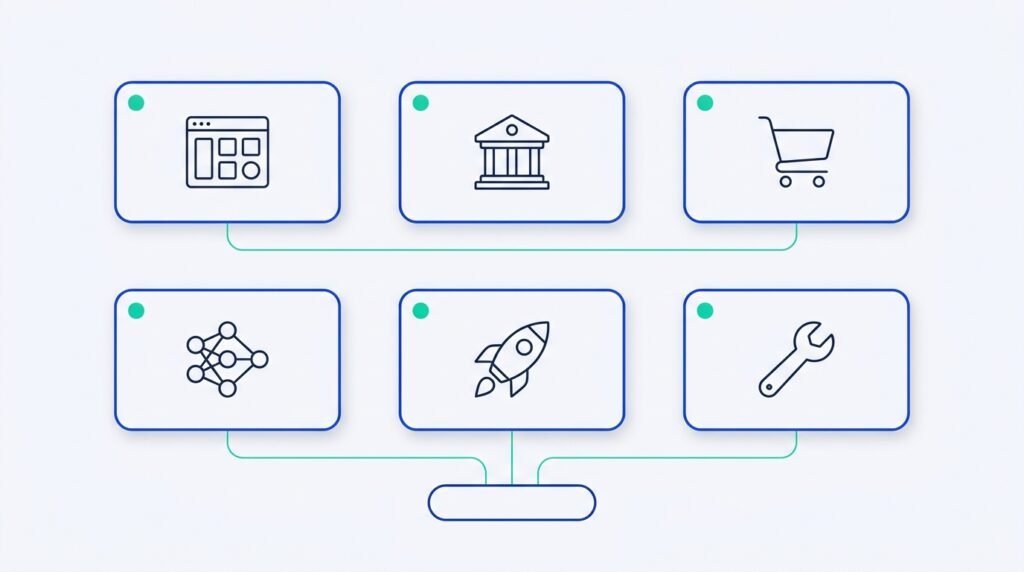
| If you’re building | Frontend | Backend | Why |
|---|---|---|---|
| SaaS platform or dashboard | Next.js + TypeScript | Node.js (NestJS) | One language across the stack, fast iteration, huge hiring pool |
| Enterprise or regulated system | Angular | .NET Core or Java | Opinionated structure survives large teams and long lifecycles |
| Content-heavy or marketplace site | Next.js or Nuxt | Laravel or Django | Mature admin tooling, strong SEO out of the box |
| AI-powered application | Next.js | Python (FastAPI) | The entire ML ecosystem lives in Python |
| MVP on a tight budget | Next.js | Laravel or Django | Fastest route to working software with a small team |
| Internal tool | Vue.js | Node.js or Django | Lower complexity, easier for a small team to maintain |
Frontend technologies
React remains the market default. Stack Overflow’s 2025 Developer Survey put it at roughly 45% usage among all developers — meaning you’ll always find people who can work on it. That’s the real argument for React: not elegance, availability.
Next.js is what most teams should actually start with. It gives you server-side rendering, static generation, API routes and image optimisation in one framework. If organic search matters to your product, this is close to non-negotiable.
Vue.js and Nuxt are gentler to learn and quicker to ship with on small teams. Adoption sits well below React, which means a smaller hiring pool — fine for an internal tool, a genuine risk for a product you plan to scale a team around.
Angular is the one people dismiss too quickly. It’s opinionated, TypeScript-first, and enforces structure — which is precisely what you want when twelve developers touch the same codebase over six years. Banks and enterprises use it for a reason.
TypeScript and Tailwind CSS are now baseline rather than optional. TypeScript catches a category of bug before it reaches production; Tailwind keeps styling consistent without a separate design system project.
Avoid: choosing Svelte or a newer framework purely on developer enthusiasm. Excellent technology, thin hiring market. Fine if your team already knows it — expensive if you need to recruit.
Backend technologies
Node.js is the most-used web framework globally at roughly 49% adoption, and it’s the pragmatic default for real-time features, APIs and anything where sharing a language with the frontend saves you a hire. NestJS adds the structure that plain Express lacks once a project grows past a handful of endpoints.
Python — via Django or FastAPI — is the correct answer whenever AI, data processing or scientific work is in scope. Django gives you an admin panel, ORM and authentication on day one. FastAPI is the faster, leaner choice for API-first products and has grown quickly as AI features have moved into mainstream applications.
Laravel (PHP) is consistently underrated by people who last looked at PHP a decade ago. For marketplaces, CMS-driven platforms and business applications, Laravel ships working software faster than almost anything else, and PHP developers are widely available and comparatively affordable in every market.
ASP.NET Core is the sensible pick for organisations already inside the Microsoft ecosystem. Ruby on Rails still moves fast for MVPs, but the hiring pool has thinned enough that it’s hard to recommend for a product you’ll staff up around.
Database, cloud and the AI layer
PostgreSQL handles the overwhelming majority of applications and now covers JSON workloads that once justified a separate document database. Reach for MongoDB only when your data genuinely has no fixed shape.
For hosting, Vercel is the path of least resistance for Next.js apps; AWS or Azure make sense when you need control, compliance, or already have infrastructure. Docker should be in the build regardless — it’s what stops “it works on my machine” from becoming a release process.
On AI: most products don’t need a custom model. They need an API call to an existing one, sensible prompt handling, and a plan for what happens when the response is wrong. Budget for the third item — it’s the one teams forget.
What choosing wrong actually costs
The bill for a bad stack decision doesn’t arrive at launch. It arrives in year two:
- Hiring friction. A niche framework can add weeks to every developer search and a premium to every salary.
- Maintenance drag. Unmaintained dependencies become security findings, and security findings become emergency sprints.
- Rewrite risk. Rebuilding a working application because it can’t scale is the single most expensive line item in software, and it’s almost always traceable to a decision made in week one.
- Vendor lock-in. Low-code platforms are genuinely fast to launch on. They’re also difficult to leave once your business logic lives inside someone else’s product.
In the UK and Australia, the hiring point matters more than it does in the US — smaller developer markets mean an unusual stack narrows your candidate pool considerably faster.
Common mistakes worth avoiding
- Choosing the stack before defining the requirements. The requirements should pick the technology.
- Optimising for scale you don’t have. Microservices for 500 users is a tax, not an architecture.
- Letting one developer’s preference decide. They may not be there in two years. The codebase will be.
- Ignoring who maintains it. Ask this before you write a line of code.
FAQ
What is the best technology stack for web app development in 2026? Next.js on the frontend, Node.js or Python on the backend, PostgreSQL for data, and a cloud platform like AWS or Vercel. It suits most SaaS products and business applications. Enterprise and AI-heavy builds vary from this baseline.
Which backend is best for a scalable web application? Node.js for real-time and API-driven products, Python for data and AI workloads, .NET Core for enterprise systems, and Laravel for business applications and marketplaces. All four scale — the difference is what they make easy.
Is PHP still worth using for web app development? Yes. Modern PHP with Laravel is fast, well-supported, and cost-effective for marketplaces, CMS platforms and business applications. The developer pool is large in every market, which keeps both hiring times and rates reasonable.
How much does it cost to build a web app? It depends on scope, but the stack itself is rarely the main cost driver — team size, timeline and integration complexity are. A mainstream stack lowers total cost mostly by making developers easier and cheaper to find.
Should I use a PWA or a native mobile app? A progressive web app is the better first move when you want one codebase across desktop and mobile and don’t need deep device features. Go native when camera, background processing or app store distribution are core to the product.
Conclusion
There is no best technology — only the right fit for a specific project, team and timeline. Next.js with Node.js or Python and PostgreSQL is the strongest default in 2026 because it’s proven, well-supported and easy to hire for. Deviate from it deliberately, for a stated reason, and document why.
If you’d rather not make this call alone, that’s what we’re here for.
Not sure which stack fits your project? Book a free 30-minute technical scoping call. We’ll map your requirements to a recommended stack and give you a realistic build estimate — no obligation, no sales script. Book a Scoping Call →
Sources block for the bottom of the post:
Sources
- Stack Overflow Developer Survey 2025 — https://survey.stackoverflow.co/2025
- Statista, Most Used Web Frameworks Among Developers Worldwide, 2025 — https://www.statista.com/statistics/1124699/worldwide-developer-survey-most-used-frameworks-web/
- MDN Web Docs, Progressive Web Apps — https://developer.mozilla.org/en-US/docs/Web/Progressive_web_apps